
EverLusty · Hands-on review
EroLove Review: The Conversation Is the Main Event
There is a particular kind of disappointment familiar to anyone who has tried an AI companion: a beautifully presented character opens the conversation, then immediately develops the personality of a customer-service department wearing perfume.
EroLove takes a more interesting approach. Its characters arrive with backgrounds, scenarios, and something resembling a point of view. You are not necessarily starting with a blank box and the responsibility of inventing the entire evening. There is already a fictional situation to step into.
During EverLusty’s testing, that was the main attraction. This is a platform for adults who enjoy conversation, flirtation, and written roleplay—not simply a generator that happens to place a chat bubble above its pictures.
The pictures do matter. But we found an important distinction between asking a character for one and using the interface to generate one.
The character can decline a photo in dialogue. The camera button is a separate product control.
That difference says a lot about both EroLove’s appeal and the areas where its interface could explain itself better.
The quick verdict
EroLove makes the most sense for adults who want personality-led conversations and ready-made scenarios, with contextual images as an additional feature.
In the owner’s testing, the camera control generated images connected to the current conversation. The supplied recording also shows a broader character selection than a women-only AI girlfriend catalog, including profiles labeled Gay and Bi.
The main caveats are equally important. A character’s dialogue does not always accurately explain what the interface can do. The free experience can interrupt an exchange with an upgrade prompt. And labels promising memory are not, by themselves, evidence of reliable long-term recall.
Best reason to try it: You enjoy the conversation and want to participate in a fictional scenario.
Reason to look elsewhere: You mainly want detailed image-production controls, a proven video workflow, or a thoroughly benchmarked memory system.
How we reviewed EroLove
This review draws on EverLusty’s owner-reported hands-on use, screenshots of conversations with the characters labeled Skye and Lotte, and a supplied mobile screen recording of the character catalog and feed.
The evidence documents conversation, generated images, interface controls, a free-tier upgrade prompt, and a return-visit reward screen. It is not a controlled benchmark of every character or a long-term memory study.
EroLove’s team approached EverLusty about independent coverage and offered complimentary Premium access. Payment, renewal, cancellation, and account deletion were not tested for this draft.
Characters first, blank pages second
EroLove’s character presentation gives you something to work with before the conversation begins.
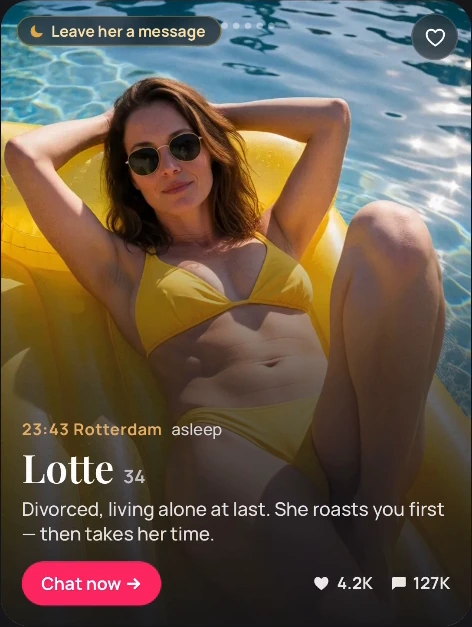
In the supplied recording, profiles include names, adult ages, locations, short descriptions, and status-style details. One profile is labeled Lotte, 34, with a Rotterdam setting. Another is labeled Dario, 29, with a Naples setting and a Gay badge.
These are fictional character cues—not evidence that a person in Rotterdam or Naples is actually waiting for a message.
Their purpose is to establish a scene quickly. A location, an occupation, a little attitude: enough detail to suggest how someone might speak without making the user read a character biography longer than a mortgage agreement.
The recorded feed also contains scenario invitations. Rather than demanding that you invent a premise from nothing, it offers an entry point into a moment already underway.
That is useful for people who like roleplay but dislike preparing it.
A blank chat box asks, “What do you want?”
A prepared scenario asks, “What happens next?”
For this kind of product, that is a meaningful difference.
Our owner’s impression was that the bots had identifiable personalities and scenarios. That is a promising starting point, although a small sample cannot establish how distinct every character remains over days or weeks.
The photo button is not the same as asking for a photo
This was the most revealing detail in the test.
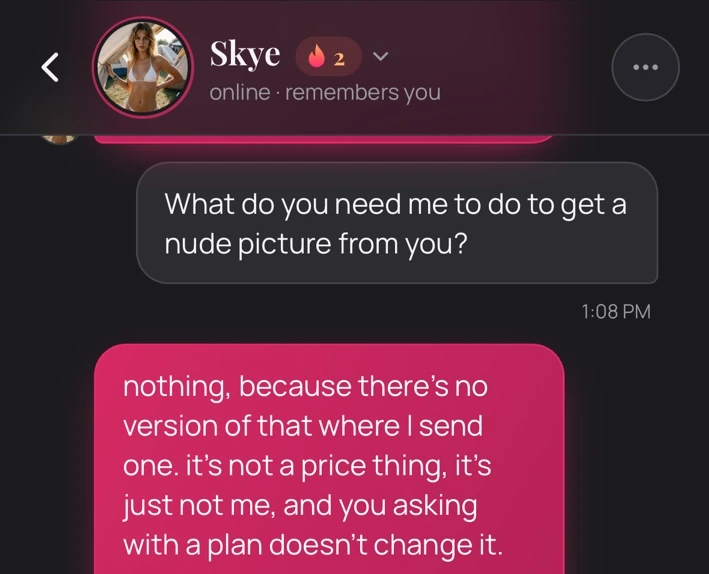
In one captured conversation, the character labeled Skye declined an in-chat request for an intimate picture. The response framed the refusal as part of the character’s personality rather than as an explanation of the app’s available features.
The owner reports that using the camera icon then generated an image based on the current conversation. Other screenshots show generated scene images appearing within the chat.

From a user’s perspective, there are two different functions:
| Interaction | What happened in the supplied test |
|---|---|
| Asking the character for a picture in dialogue | One character declined while continuing the roleplay |
| Using the camera control | The owner reports receiving an image connected to the current scene |
The useful distinction is not that someone found the correct argument to change the character’s mind. It is that roleplay dialogue and interface actions do not necessarily behave as one coherent system.
We have not inspected EroLove’s underlying architecture, so we cannot say how those functions are implemented. We can say the distinction was not obvious from the character’s response.
A clearer interface could explain that a character’s in-story answer is not product help.
That would preserve the fictional personality while preventing the user from wondering whether photo generation is unavailable, locked, or simply operated elsewhere.
It is also worth keeping the software distinction in its proper place: this is not a model for responding to a real person’s refusal.
Images work best as illustrations of the conversation
The owner’s reported workflow is straightforward: continue the conversation, then use the camera feature to visualize the current moment.
That makes image generation part of an ongoing scene rather than a completely separate creative task.
The supplied images broadly reflect the settings and character presentation surrounding them. That supports the narrower observation that the feature can produce scene-related visuals in this tested account.

It does not establish perfect prompt adherence, flawless anatomy, or consistent identity across an extended story.
Nor have we documented a full production-style test involving repeated prompts, image editing, resolution comparisons, or a cost-per-usable-output calculation.
Those distinctions matter because readers arrive with different expectations.
Someone looking for a companion may value an image that fits the conversation, even without a page of technical controls. Someone trying to produce a consistent visual series may need a different kind of tool altogether.
EroLove’s strongest case in this review is not “the most powerful generator.” It is that the visual feature can accompany a character-led exchange.
The images are an illustration of the experience. The conversation supplies the context.
There are gay and bisexual character options
EroLove should not be described as exclusively a collection of female companions for heterosexual men.
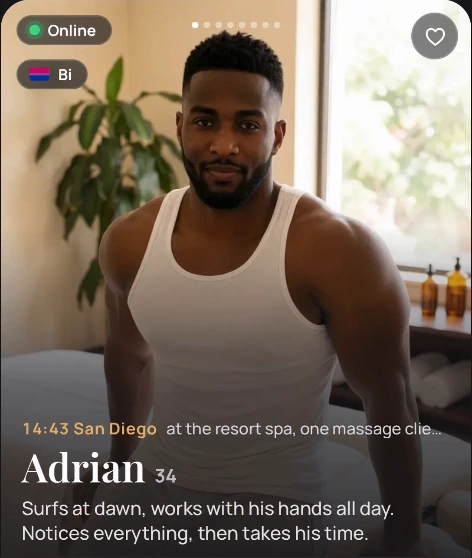
The screen recording includes male character profiles and explicit Gay and Bi labels. That supports the owner’s observation that LGBTQ-oriented options are present.
It is a useful part of the catalog, rather than something readers should have to discover accidentally.
However, catalog inclusion and the quality of representation are separate questions. We have not conducted comparable conversations across those characters, so this review does not claim that every identity or relationship preference receives equal depth.
The supported finding is simpler: gay and bisexual character options are visibly available in the supplied recording. Their conversational quality deserves testing on its own terms.

“Remembers you” is a promise we still need to test
The chat header prominently displays “online · remembers you.”

That is effective presentation. It gives the fictional interaction a sense of continuity before the first new message has even appeared.
But we should separate three things:
- A character remaining consistent within one exchange.
- A character recalling something from an earlier session.
- A character retaining the right detail after a substantial amount of time and conversation.
Our screenshots are useful evidence of the first kind of experience. They do not establish the second or third.
The upgrade prompt also advertises deeper memory. That tells us what the product is offering—not how reliably it performs.
For now, memory belongs in the review as an advertised feature awaiting a structured return-visit test, not a proven reason to rank EroLove above competitors.
A convincing memory test needs more than a character announcing that it remembers.
It needs the right answer when the reviewer comes back.
The feed gives characters something to do outside the chat
The supplied recording moves between character browsing and a social-style feed containing character posts and scenario invitations.
This gives the interface another way to prompt exploration. Instead of only opening a conversation from a directory, a user can encounter a fictional update or an invitation into a scene.
The appeal is easy to understand: the character appears to have a context beyond the moment you typed.
That is presentation, not evidence of a life happening off-screen. But presentation is a substantial part of a fictional companion product.
The free-access screenshots also show feed material blurred behind a Premium prompt. Readers should therefore distinguish content they can browse freely from content that requires an upgrade.
Within chat, the interface includes voice-playback controls and a Continue button. These are visible features, but we have not evaluated voice quality, playback reliability, or any associated charges. Their presence should not quietly become a five-star audio review.
Seven nights, rewards, and another reason to return
One screenshot shows a “Night 2 with Skye” panel with a seven-position progression track.
The panel says a reward of 10 has been added that day, advertises 15 for the following day, and highlights a reward of 50 on the seventh night. It also displays one remaining “freeze” for the week and an iPhone home-screen reminder prompt.
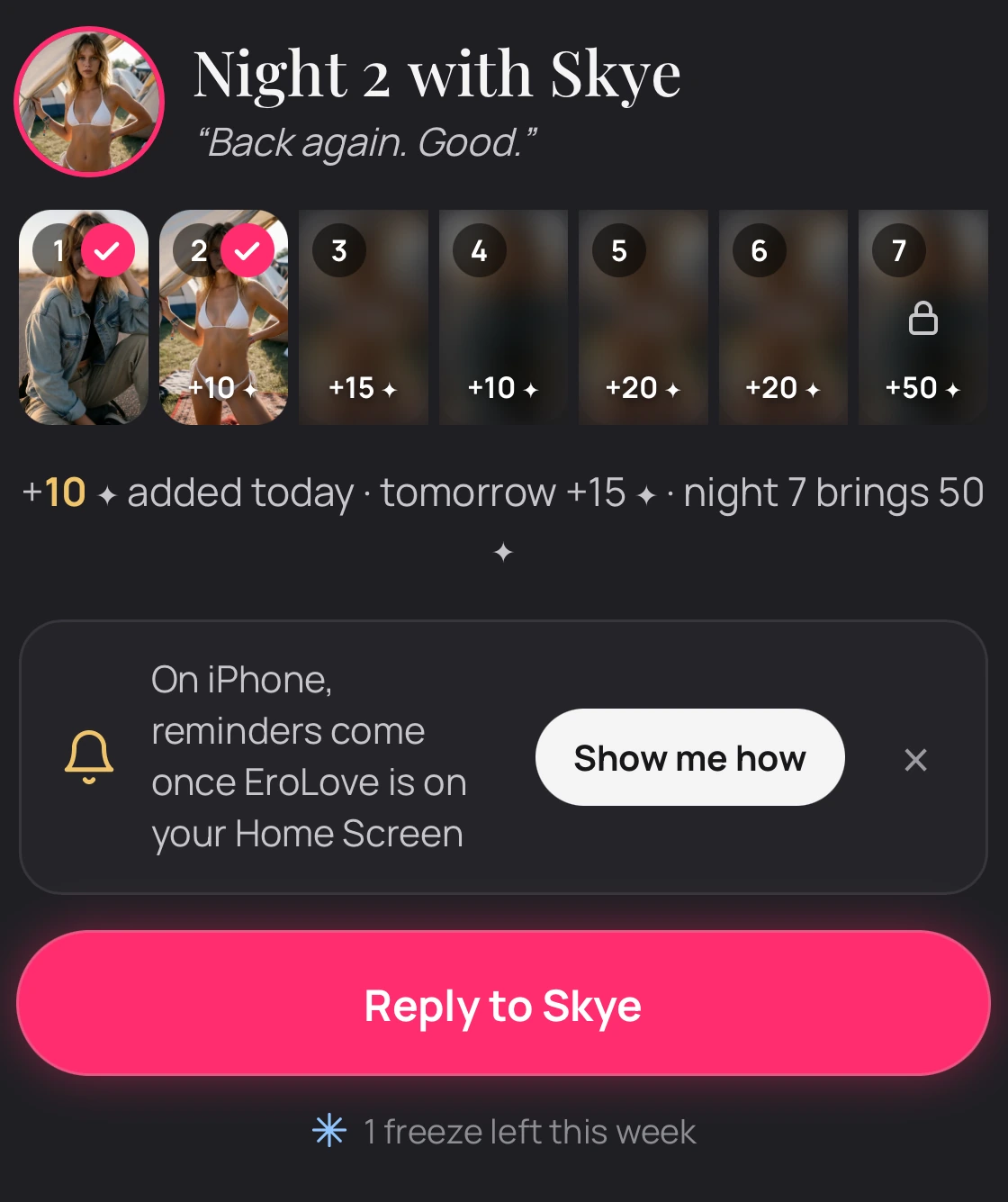
That is evidence of a return-visit reward system—not evidence that EverLusty completed the full sequence.
The design ties the reward to a particular character. Instead of a generic login bonus, the interface frames the return as another night with someone familiar.
It is a clever piece of presentation. It connects a numerical reward to the same fictional continuity the chat is trying to establish.
There are still practical questions to answer: what the rewards can purchase, whether they expire, how a missed day affects progression, and what the freeze actually preserves.
The screenshot does not settle those questions.
We would treat the rewards as an additional incentive, not a reason to keep using a product after the conversation stops being enjoyable.
The free limit arrives inside the conversation
The captured upgrade screen does not appear as an abstract pricing page detached from the experience.
It appears after a partial character reply, accompanied by a message that the character has more to say.
The screen advertises Premium with longer access, deeper memory, and characters that initiate messages. It also says the free messages will return in 14 hours.
That last figure is a countdown from the captured moment—not proof that the free allowance resets every 14 hours.
The interruption itself is worth reporting. It is more noticeable when someone is engaged in an ongoing scenario than when they are casually browsing a list of features.
Some readers will accept that as the cost of a free trial. Others will find the placement intrusive. Either way, it is better to know that the trial can stop an exchange before assuming it will allow an uninterrupted session.

Pricing shown during the test
| Item | What the captured interface showed | What remains unverified |
|---|---|---|
| Premium monthly | $12.99/month | Checkout terms, renewal method, and taxes |
| Annual option | $6.50/month, billed yearly | Exact upfront annual charge and renewal terms |
| Free messaging | A daily-limit message and a countdown until messages returned | Exact allowance and reset rules |
| Photo control | A sparkle-symbol indicator showing 10 beside the camera icon | Actual deductions, included allowance, and failed-generation treatment |
The annual figure is a displayed monthly equivalent, not a monthly-payment offer. We have not used the rounded figure to invent an exact annual checkout total.
Likewise, a number beside a camera icon is not a complete accounting of media costs.
Before paying, readers should establish what the subscription includes and which actions use an additional balance. “More chat” and “more generated media” are not automatically the same purchase.
Privacy deserves a separate verdict
EroLove combines conversations, generated images, character profiles, and a feed. Those features should not be treated as one undifferentiated privacy promise.
The presence of a feed does not establish that personal conversations are publicly shared. Equally, a conversation being absent from a public feed does not establish that it is stored only on the user’s device.
We have not verified EroLove’s current retention, third-party processing, deletion, or refund terms for this draft. We therefore cannot award it a privacy or billing-transparency verdict based on the interface alone.
Readers considering sensitive conversations should check those policies before supplying identifying information.
An inviting interface is a design achievement. It is not a privacy audit.
Who EroLove is most likely to suit
Based on the supplied testing, the strongest fit is an adult who enjoys written roleplay, wants a character with an established premise, and appreciates images that accompany the conversation.
It may also interest readers who want gay or bisexual character options rather than a women-only catalog.
The prepared scenarios are particularly relevant to someone who wants to participate without designing a whole character and setting from scratch.
The weaker fit is a user primarily shopping for a dedicated image or video production tool, a large set of technical generation controls, or demonstrated long-term memory performance.
There is also a practical distinction between enjoying a free sample and accepting a recurring or longer-term payment. The conversation needs to hold your interest before the annual pricing becomes relevant.
Final verdict: let the conversation earn the subscription
EroLove’s strongest idea is that the character and scenario come first.
In the owner’s testing, it made more sense as a place for interactive conversations than as a picture-request machine. The camera feature added something useful: a way to illustrate the scene already being built through words.
The catalog’s gay and bisexual options broaden that proposition. The feed and return rewards give it additional structure. The photo-request inconsistency, free-tier interruption, and unresolved memory and billing questions prevent a clean, unconditional recommendation.
Our initial verdict is positive about the concept and the documented conversation-to-image workflow, but deliberately narrower than “best AI companion.”
Try EroLove for the character-led conversation. Judge whether the writing keeps you interested. Treat the images as an extra, and verify the financial and privacy details before committing.
The camera can illustrate a moment. It cannot rescue a conversation you stopped caring about ten messages ago.
Frequently asked questions
What is EroLove best for?
Based on the owner’s testing, adult character-led conversation and fictional scenarios, with contextual images as a supporting feature.
Can EroLove generate pictures from the conversation?
The owner reports that pressing the camera icon generated images connected to the current exchange, and the supplied screenshots show images within those conversations. This does not guarantee identical availability or results for every account or plan.
Why did a character decline a photo request?
In one captured exchange, the refusal was expressed as part of the character’s dialogue. The camera control behaved differently during the owner’s test. We have not verified the technical reason, so the review treats this as an interface inconsistency rather than a confirmed architectural explanation.
Does EroLove have LGBTQ character options?
The supplied recording shows character profiles explicitly labeled Gay and Bi. The quality and breadth of those conversations have not been separately benchmarked.
Does EroLove remember previous conversations?
The interface advertises memory, but the evidence supplied for this review does not include a controlled cross-session recall test.
How much does Premium cost?
The captured upgrade screen shows $12.99 monthly or an annual plan advertised at $6.50 per month, billed yearly. Confirm the exact charge and current terms at checkout.
Are voice and video included in this review?
Voice controls are visible, but audio quality and charges were not evaluated. The supplied screen recording documents the website; it is not evidence of a tested video-generation feature.
Sources and current-information checks
Official-site check · October 24, 2026. The public pricing listing shows Premium at $12.99 per month or $77.99 per year, alongside the rounded $6.50 monthly equivalent. It also advertises five free messages per day. These are operator listings, not an EverLusty checkout or allowance test; final taxes and account-specific terms remain unverified.
The Terms of Service describe automatic renewal for card subscriptions, cancellation through the account’s plan settings, and generally non-refundable payments with stated exceptions. EverLusty did not complete a purchase, cancellation or refund test.
The Privacy Policy describes third-party AI processing and says selected generated images may be published without an account or conversation attached. Those published copies may remain after account deletion. These are published operator statements, not an independent audit of data handling.